
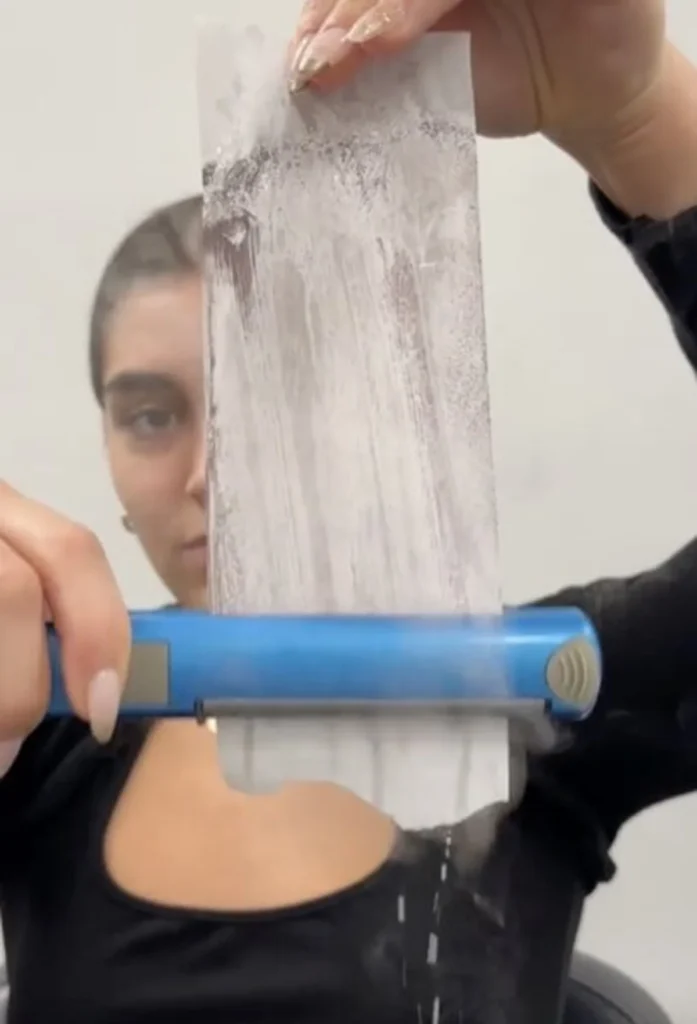
I was scrolling through my morning beauty news when yet another video showed up: someone spraying a heat protectant on a thermal paper receipt, pressing a flat iron over it, and declaring victory because the paper stayed white.
It sounds clever. Receipts darken with heat. Less darkening means less heat reaching the paper. Less heat means better protection for your hair. The logic is clean — until you start poking at it.
I had to know if this test actually tells us anything useful about the products sitting on my vanity right now.
Why This Test Seems Plausible
We all know how many beauty tests fall apart the moment you realize your skin isn’t a tomato. But thermal receipts have surface validity here: hair gets damaged by excessive heat, and receipt ink darkens with heat too. In science, we call something like this a model — a stand-in that behaves similarly enough to the real thing to give us useful information.
The question is whether thermal paper changes color at the same temperature where hair actually starts getting damaged.
The Original Test — And One Detail That Changes Everything
I started by watching Lucy Seitz, a cosmetologist who runs one of the most popular series of these receipt tests. She’s systematic: she states her straightener temperature (340 °F / 170 °C) and uses a control.
But here’s what caught my eye — the receipts in her videos look wet. When a commenter pointed it out, she added a drying step to subsequent tests. Yet some receipts still appeared to be dripping.
This matters. Water soaks up heat incredibly well due to its hydrogen bonding. A wet receipt could look lighter not because the product is protecting it — just because there’s water still evaporating off the surface.
Day 1: My First Round of Tests
I gathered 11 products with heat protection claims across different formulas:
- 7 pump sprays: Marc Anthony Repair Bond Rescueplex, got2b Guardian Angel, Cedel Blow Dry Faster, L’Oreal Elvive Colour Protect, TRESemme Heat Defence Care & Protect, Goldwell Sleek Perfection, and ghd Heat Protect Spray
- 1 propellant spray: IGK Good Behaviour Spirulina Protein Smoothing Spray
- 3 cream products: Redken Acidic Bonding Concentrate Leave-In Treatment, L’Oreal Elvive Dream Lengths No Haircut Cream, and L’Oreal Elvive Smooth Intense Heat Protect Cream (230 °C / 446 °F)
I applied each product to a receipt — not controlling the exact amount, because I wanted to replicate how most of us actually use these products. Then I let them dry for about 15 minutes before running my straightener (set to 170 °C / 338 °F) over them.
The lightest receipts were the creams. That makes sense — creams apply more thickly, creating a thicker insulation layer with more residual water. The darkest two were the Goldwell and IGK sprays, both of which have water low on their ingredient lists.
There was also a striking difference between testing at 0 minutes versus 15 minutes with the same product. Drying clearly makes a big difference.
A Grey Surprise
Two things threw me off. The Cedel and IGK sprays turned parts of the receipts light grey right after application — something I hadn’t seen in Lucy’s tests at all.
I went back to watch her videos more closely. There were grey spots in her receipts too — subtle, easy to miss against shadows or wetness. And the edges of those grey areas lined up exactly with where the paper stayed white after heating.
Water Alone Tells a Story
To isolate water’s role, I dunked and sprayed receipts with plain water at different drying intervals — immediately, 2 minutes, 5 minutes, and 10 minutes — then ran the straightener over them.
Dunking kept receipts white across all time points. Spraying showed a clear gradient: lighter at 0 minutes, grey by 2 minutes, black by 5 minutes.
Water clearly does a lot of the cooling work — but only while it’s still present on the paper. Once it evaporates, the receipt darkens just like an unprotected one would.
Day 2: The Plot Thickens
I kept a second set of receipts from Day 1 and tested them again 24 hours later — thoroughly dry this time. I assumed they’d all be much darker without residual water cooling things down.
They very much weren’t.
The sprays actually looked lighter on Day 2 than Day 1. This was the opposite of what residual water would predict — something else had to be going on.
What Temperature Do Receipts Actually Change?
I started researching thermal paper structure and found a confusing range: some sources say 150–185 °C, others cite much lower numbers. A German paper referenced by Wikipedia put the melting point of thermal paper substances at 40 to 80 °C (104–176 °F).
A thermal paper company stated: “Thermal paper begins to develop color between 60 to 100 °C (140–212 °F) and reaches applicable density between 70 and 120 °C (158–248 °F).”
If receipts change color at the lower end of this range — say, 50 °C / 122 °F — then the test would be useless for hair. Hair doesn’t get damaged until around 100 °C / 212 °F.
I tested it myself: I poured boiling water on a receipt, and it changed color. Then I cooled water to different temperatures and dipped receipt strips in. Most receipts turned black around 95 °C (203 °F). That aligns reasonably well with the temperature where hair damage begins.
The Real Answer: It’s Not About Cooling — It’s About Dissolving
At this point, I had observations that water alone couldn’t explain. Some products kept receipts far too white for a thin layer of liquid to account for. The sprays got lighter on Day 2. And some receipts turned grey immediately upon application.
I tested the sprays that went grey and found they all had high amounts of alcohol. That led me to a new hypothesis: the heat protectants that “work” on this test aren’t blocking heat — they’re dissolving the ink layer on the receipt.
Thermal paper has a special invisible ink layer made of multiple components frozen in a solvent, almost like wax. Heat melts the solvent so the parts combine and form black ink. Alcohol is a good solvent that can dissolve oilier substances than water — so it messes up this delicate ink arrangement before heat even arrives.
Confirming with Other Substances
I tested alcohol, water, and glycerin individually. Alcohol kept the receipt light — and diluted alcohol made it even whiter than pure alcohol alone.
Water and glycerin didn’t disturb the ink much, which makes sense since receipt inks are too oily for them to dissolve. Perfume made receipts immediately grey and kept them white with heating. Dry shampoo went grey but didn’t stay white after heating — it lacks humectants, so alcohol evaporates too quickly.
I also tested surfactants. Micellar water and water with detergent kept receipts white. Moisturizers contain emulsifiers (a type of surfactant) that dissolve oil — both CeraVe Moisturizing Cream and Laneige Cream Skin kept the paper white. Sunscreens, which often contain both alcohol and surfactants, did too.
Volatile silicones had little impact — they’re too oily to dissolve the ink layer well and evaporate quickly, which explains why some silicone-heavy products “fail” this test.
So What Does This Mean for Your Heat Protectant?
The receipt test mostly shows which products are good at dissolving the top layer of thermal paper — and to a lesser extent, whether they’re still wet. It has nothing to do with which heat protectant works best on actual hair.
Heat protectants don’t work by blocking heat. They help heat spread out more evenly across your strands so you avoid hot spots. Effective ingredients include silicones, polymers, and hydrolyzed proteins. And if the product contains water (most do), make sure it has time to dry before you touch a hot tool to it.
For real answers, look for brands that test on actual hair — not paper. Some even show footage of their testing methods, like Amika’s comb-repetition machine tests.
FAQ
Q: Should I still use heat protectants?
Absolutely. They just don’t work the way this receipt test suggests — they help distribute heat evenly and condition hair so it resists snagging in hot tools.
Q: Do sprays or creams protect better?
The receipt test can’t answer that. Creams apply thicker layers with more water, but that doesn’t mean they shield your hair from heat any better than a well-formulated spray.
Q: How do I know which heat protectant to buy?
Look for products with silicones, polymers, or hydrolyzed proteins. Check if the brand mentions specific testing temperatures or “instrumental tests” on packaging — that’s a sign they’ve done real hair testing.
A note from the studio: I bought my first heat protectant because a receipt test video convinced me it was the only one that “worked.” Turns out, what really matters is whether you find a formula your hair likes — and whether you let it dry before cranking on the straightener.
Tested on my vanity, not on my ego.
Keep Reading
- How to Really Fix an Itchy Scalp: What the Science Actually
- Is Synthetic Braiding Hair Giving People Cancer? The Truth B
- My Current Haircare Favourites