

I stood in front of my bathroom mirror last Tuesday, holding a pack of synthetic braiding hair that smelled faintly like a nail salon. You know the one — that sharp, clean-but-slightly-chemical whiff you get before dipping it into hot water. I have worn braids for years and always assumed the smell was just part of the process.
Then in February 2025, Consumer Reports announced they found carcinogens in all 10 synthetic braiding hair products they tested. The headlines said our health — and the health of everyone who gets their hair done — was at risk.
But after digging into the actual numbers behind those findings, I am not nearly as worried as the press releases made me feel. And I think you should not be either.
The headline says it all — or does it?
Consumer Reports’ main finding: Dangerous chemicals were detected in 100 percent of the braiding hair we tested.
Carcinogens showed up in every single product. Lead was found in nine out of 10. Volatile organic compounds, including acetone, appeared in all samples.

Sounds alarming. But there is one detail the headline does not mention — and it is the most important one: how much of these chemicals were actually there?
In toxicology, the dose makes the poison. If you have enough of anything, it can be harmful. If you have a small enough amount, it probably will not be.
Consumer Reports found carcinogens in 10 out of 10 synthetic braiding hair products. But the amounts detected are extremely low — far below everyday exposure levels for most substances. The real culprits behind irritation may be something else entirely.
Benzene: less than you think
Benzene is a known carcinogen linked to acute myeloid leukemia. It was detected in 4 out of 20 measurements, at levels between 15 and 18 micrograms per kilogram (μg/kg).
A typical long braid style uses about a pound — roughly 0.5 kilograms — of hair. That means less than 9 micrograms of benzene in the entire head.
Put that into perspective:
- If you live in a city, you inhale around 60 μg of benzene per day — six times what is in half a kilo of hair.
- Cooking on a gas stove produces about 100 μg.
- Filling your car with petrol exposes you to roughly 110 μg in just 5 minutes.
Braided hairstyles last weeks or sometimes months. If we go with 4 weeks (28 days), the benzene from synthetic hair works out to an average of just 0.32 μg a day. Your daily benzene intake from breathing city air is 187 times higher.
Methylene chloride: nearly invisible amounts
This solvent showed up in all samples, mostly under 20 μg/kg. The highest measurement was 54 μg/kg — which gives us about 27 μg of methylene chloride in half a kilo of hair.
To put that in perspective: it is roughly one two-thousand five-hundredth (1/2500th) of a single drop.
Australia’s safe work guidelines allow 1.74 million μg to be inhaled daily — over 60,000 times the total amount found in the worst synthetic hair sample. The drinking water guideline allows 0.004 mg per liter. If one million people drank 8 μg of methylene chloride every day for 70 years, fewer than one person would be expected to get cancer from it.
The amount in half a kilo of the worst hair, divided over 28 days, is 0.96 μg — eight times less than that already-reassuring benchmark.
Lead: concerning or context-dependent?
Lead was detected in nine out of ten products, and Consumer Reports said these levels “could be concerning over time.”
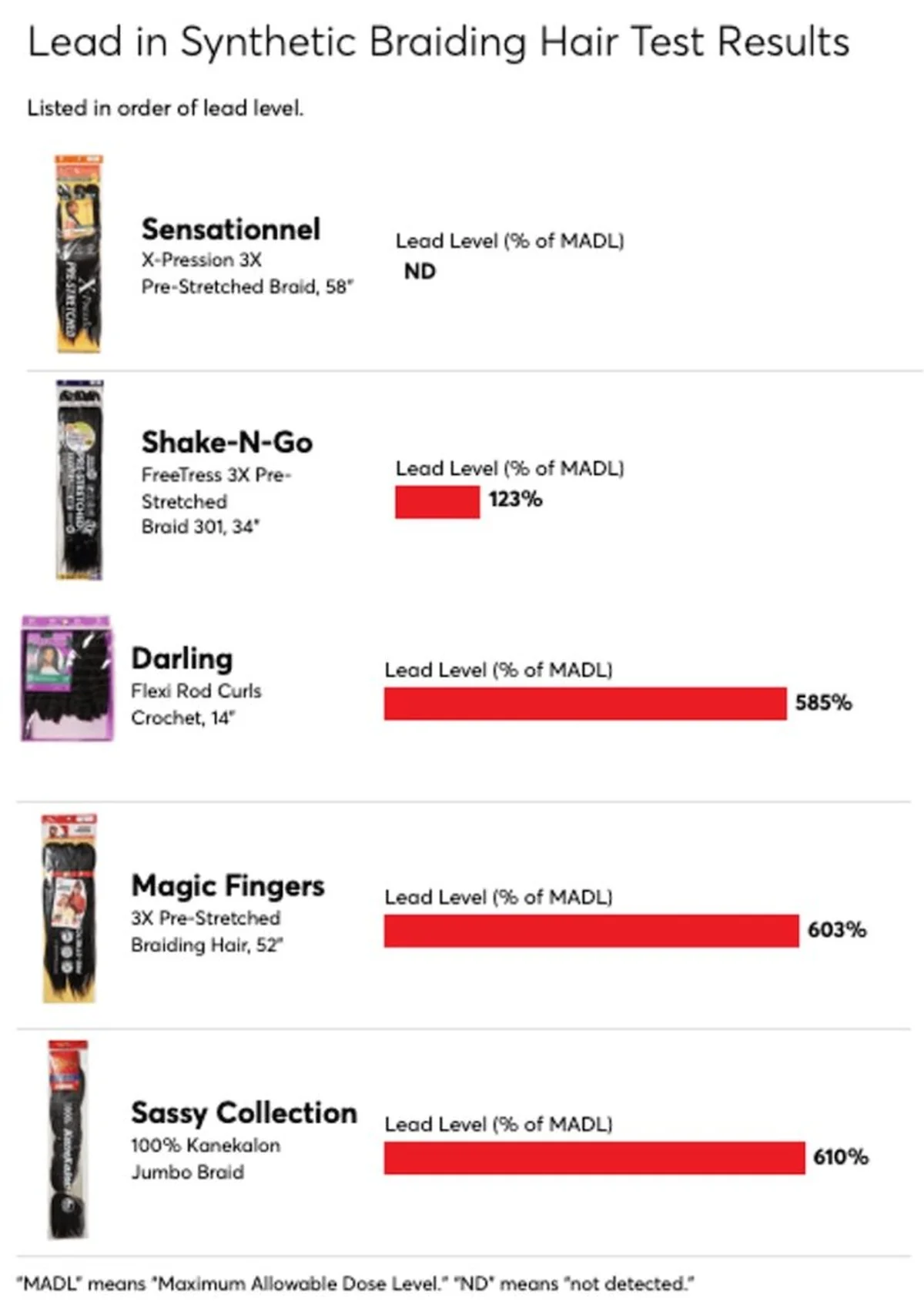
They compared the results to California’s food limit for lead — 0.5 μg per day — which is the most protective standard in the US. The products ranged from 123 to 610 percent of that Maximum Allowable Dose Level (MADL), or 1.2 to 6.1 times above it.
But here is what they did not say explicitly: those numbers assume you eat about 25 grams of hair every day — roughly the size of a tennis ball. If that much were actually going down, a full head of braids (0.5 kg) would be gone in 20 days.
The Australian drinking water guideline allows 10 μg of lead per day for young children — 20 times higher than the MADL. You would need to eat about 80 grams of the most leaded hair each day to reach that level.
VOCs: acetone is hiding the real picture
The report measures total volatile organic compounds by sealing hair in a flask and boiling it for 10 minutes. In real life, braiders dip hair into hot water for maybe 10 to 15 seconds — and ventilation makes a huge difference.
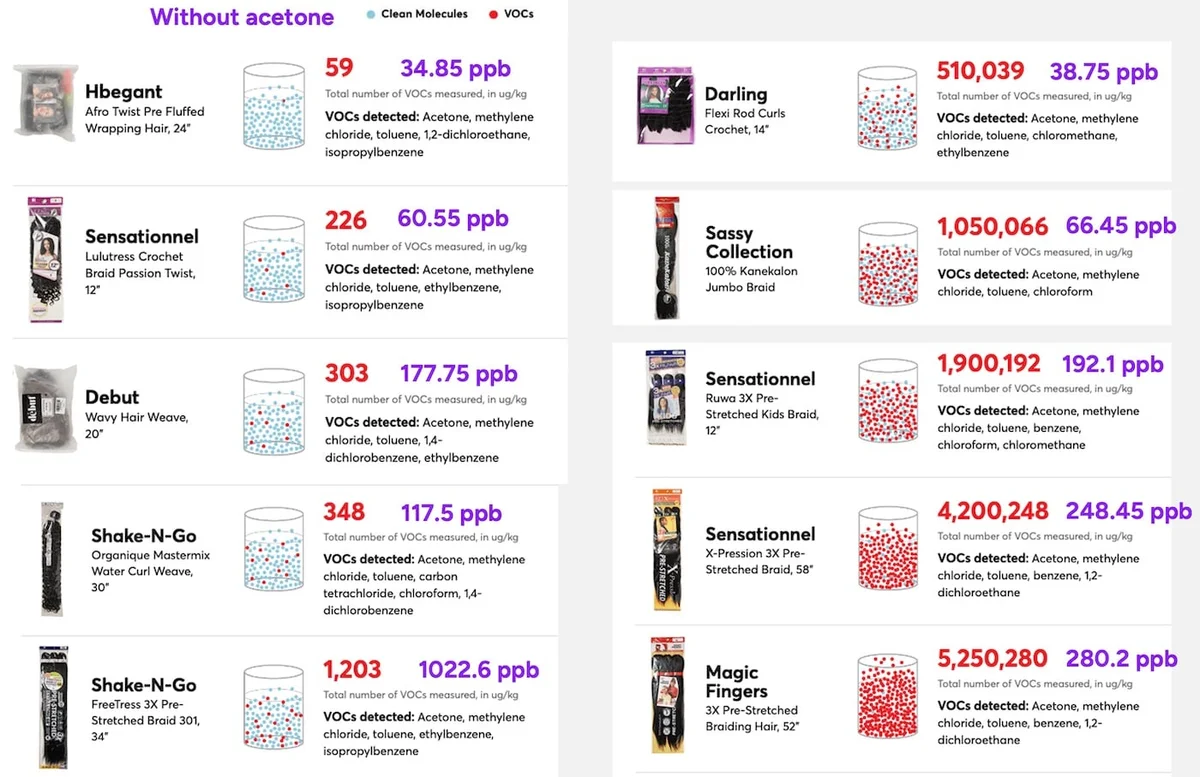
The main VOC found in every sample was acetone. Five samples contained between 390,000 and 5,900,000 μg/kg; four had much lower levels of 120 to 290 μg/kg. Acetone is the same substance you find in nail polish remover — very safe, though it can irritate at high concentrations.
When you subtract acetone from the total, the differences between products shrink dramatically. One brand that looked thousands of times worse than another suddenly looks about the same. The highest remaining VOC level (styrene) would need to fully evaporate into a box around 833 milliliters in size — roughly three and a half cups — for you to hit safe work limits after breathing it for 8 hours.
So what is actually causing the irritation?
The Consumer Reports study was prompted by a student named Chrystal Thomas, who wrote about throat irritation and a strong smell from her synthetic braids even after multiple washings. Those symptoms are not explained by the tiny amounts of benzene, methylene chloride, lead, or styrene detected in the tests.
More likely culprits:
- Rashes and swelling: Some people have raised concerns about irritating coatings on synthetic hair — which is why it is often washed before use. Acrylate allergies are rising, especially with at-home gel kits.
- Tight braids: Beyond discomfort, they can cause traction alopecia (hair loss).
- Other potentially toxic ingredients: Synthetic hair is not classified as a cosmetic product, so ingredient transparency is limited.
A quick note on Consumer Reports themselves
I have always appreciated their annual sunscreen testing. But in recent years, especially with personal care products, they seem to lean into fear-driven framing.
In December 2023, they partnered with a company called Made Safe on baby wipes. Their science advisory board includes naturopaths, an herbalist, and a homeopathic medicine doctor — an interesting mix for a panel meant to evaluate scientific evidence.
What should you do?
If the headlines made you nervous, take a breath. The carcinogens and heavy metals in synthetic braiding hair are present but at extremely low levels — well below everyday exposure thresholds.
- Wash your hair before use. Dipping it in hot water for 10 to 15 seconds removes surface coatings and much of the initial chemical smell.
- Ventilate when boiling or heating hair. Open a window or turn on a fan — fresh air helps with any VOCs that evaporate into the bathroom.
- If you get rashes, consider acrylate sensitivity. This is increasingly common and worth discussing with your dermatologist if irritation persists.
Is synthetic braiding hair safe for children?
The lead levels detected in braiding hair are very low. For context, a tenth of a TicTac’s worth of soil has similar lead content to half a tennis ball of the most leaded synthetic hair. Children chewing on their braids are not likely to be exposed to concerning amounts.
How long does benzene stay in braiding hair?
Benzene is volatile and dissipates over time. The estimated 0.32 μg per day figure assumes the entire amount remains for 4 weeks (28 days). In practice, much of it likely evaporates during initial washing and installation.
Should I avoid synthetic braiding hair altogether?
Based on the Consumer Reports data, the cancer risk from benzene, methylene chloride, lead, and VOCs in synthetic hair is very low. If you experience irritation, it may be worth trying a different brand or ensuring good ventilation during application.
A note from the studio: I bought my last pack of braiding hair because it was on sale — not because I had studied its ingredient list. After reading through these numbers, I felt better about that impulse purchase. Tested on my vanity, not on my ego.