
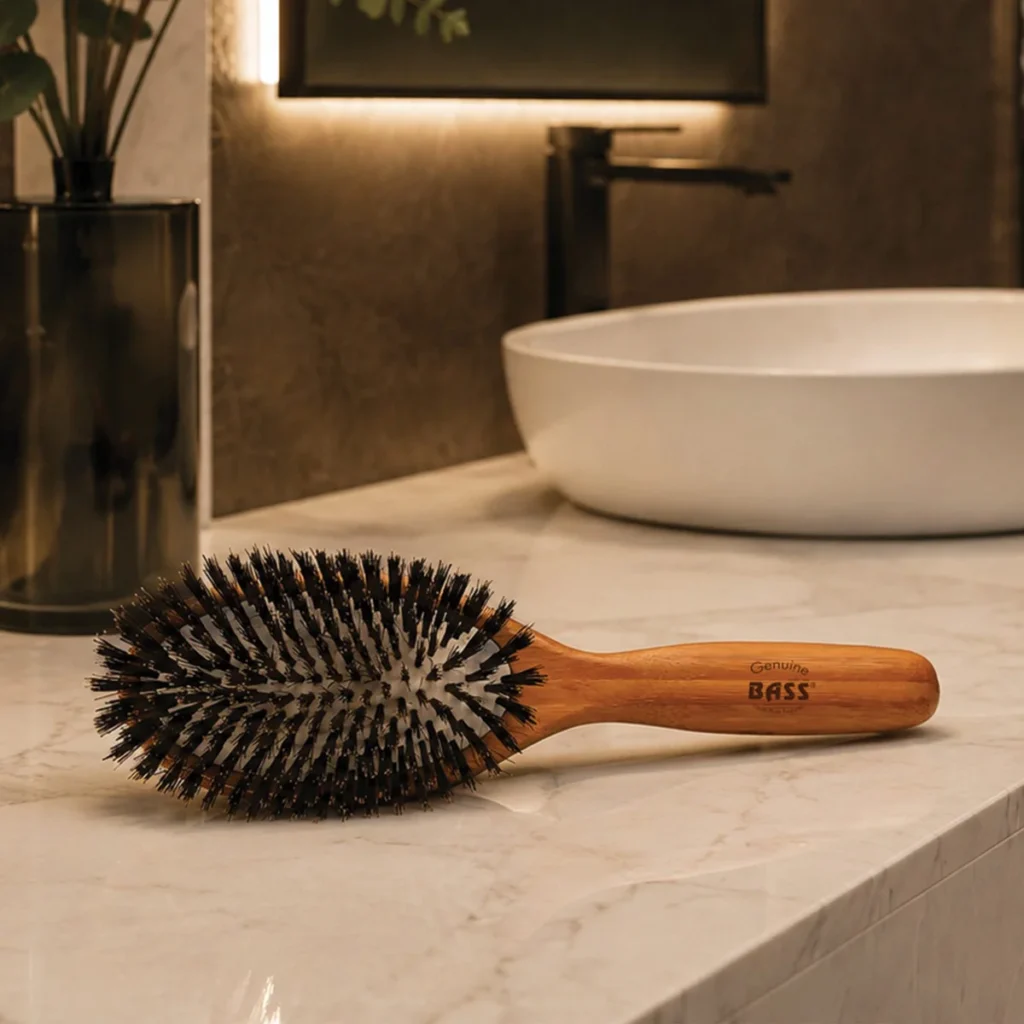
I stood at my vanity this morning, reaching for yet another shine serum I’d bought because the bottle looked expensive on the shelf. Spoiler: my hair looked exactly the same with and without it.
That’s when it clicked. The most natural conditioning agent isn’t sitting in a bottle on my counter. My scalp is producing it right now — every day, whether I pay attention or not.
The question isn’t how to add shine. It’s how to move the oil that’s already there. And the oldest tool for doing exactly that might be the one most people reach past in a hurry: the boar bristle brush.
What Boar Bristle Brushes Are Actually Designed to Do
A boar bristle brush doesn’t behave like the brushes we grab when hair is tangled or wet. It won’t pull through knots quickly, stretch damp strands into shape, or create volume under heat. Its job is quieter and more cumulative.
In professional terms, it belongs to maintenance and finishing. It works best on dry, already-detangled hair that’s ready to be conditioned and refined rather than corrected. When you use it through knots or on wet strands with heavy pressure, it can seem useless — but the brush isn’t failing. It’s just being asked to do the wrong task.
Unlike a detangling brush that separates strands, or a round brush that shapes hair with tension and heat, a boar bristle brush works by controlled contact. It lightly engages the scalp, gathers natural oil at the root, and carries it along the shaft over repeated passes. Its value shows up over time: softer lengths, calmer surfaces, less dry friction, and a steadier kind of shine.
It has two connected roles. The first is conditioning: moving sebum from scalp to ends so the body’s own conditioning system reaches the areas that need it most. The second is refinement: once hair is dry and styled, those same bristles can smooth flyaways, settle loose fibers, and polish the visible surface — often without adding another drop of product.
Sebum Distribution: Your Scalp’s Built-In Conditioner
We tend to treat scalp oil like a problem. Something to wash away, absorb, or disguise. But sebum is the body’s natural conditioning system. It lubricates the hair fiber, protects the scalp environment, reduces dryness, and keeps strands flexible.
The difficulty isn’t that the scalp produces too much oil. The difficulty is that oil stays too close to where it starts.
Sebum emerges at the roots but doesn’t automatically travel down the lengths and ends. Long hair increases the distance. Frequent washing removes oil before it distributes. Texture and curl patterns create bends and resistance that slow movement further. The result: oily roots while mid-lengths and ends sit dry, dull, or rough.
This is often mistaken for excess oil when it’s really misplaced oil. The scalp has produced what the hair needs — the conditioning material just hasn’t reached the areas that need it.
A boar bristle brush addresses this through redistribution, not replacement. It doesn’t add something foreign to the hair. Through repeated contact, the bristles pick up small amounts of sebum near the root and carry it outward along the shaft. Over time, this supports softer lengths, calmer ends, and a more balanced relationship between scalp and strand.
Conditioners, masks, serums, and oils absolutely have their place — especially in damaged or color-treated hair. But replacement and redistribution are different philosophies. One adds substance from outside. The other works with what your body already makes.
How Oil Distribution Supports Shine and Cuticle Behavior
We talk about shine as though it’s a substance: something sprayed, glossed, or sealed onto the surface. But shine isn’t simply added to hair. It’s the visible result of a surface that’s smooth enough and lubricated enough to reflect light cleanly.
Shine is not greasiness. Greasiness happens when oil accumulates too heavily in one place — usually near the scalp. Shine is an optical event. It appears when the cuticle, which is made of overlapping scales, lies flat and uniform, allowing light to move across the strand with less scatter.
When those scales are lifted, chipped, or dry, the surface becomes rougher. Light breaks apart instead of reflecting cleanly. The hair looks dull or frizzy even when it’s been freshly washed.
Dryness plays a major role here. Under-lubricated hair creates more friction as strands rub against each other, against clothing, pillows, and styling tools. That daily wear disturbs the cuticle over time — quiet, cumulative damage from dry surfaces catching against one another.
Evenly distributed sebum reduces that friction. When natural oils are guided along the shaft, they create a lighter layer of lubrication. Done properly, this doesn’t make hair greasy. It helps strands move with less resistance and gives the cuticle a better environment to stay calm. The shine that follows feels quieter — less artificial, less dependent on a fresh coat of product.
Why Boar Bristle Is Suited to Oil Movement
The brush works because the material matches the task. Boar bristle is a natural keratin-based fiber, closer in structure to human hair than many smooth synthetics. Its surface isn’t perfectly slick — it has a fine, scale-like texture that interacts with oil in a controlled way.
As the brush contacts the scalp and moves through dry hair, the bristles collect a small amount of sebum, hold it briefly, then deposit it more evenly through the lengths. A smooth synthetic may push oil around or smear it. Boar bristle participates in the transfer — it becomes a temporary carrier between scalp and strand.
Boar bristle also tends to produce less static than many synthetics. When strands repel each other, the surface scatters: flyaways lift, frizz appears, polish disappears. By combining oil movement with lower static, boar bristle helps hair settle rather than scatter.
Surface Refinement: The Professional Finishing Touch
If oil distribution explains how boar bristle brushing supports condition, surface refinement explains why stylists keep reaching for it at the end of a service. Surface refinement is the organization of the outer visible layer — the part that catches light and determines whether a finished style looks polished or incomplete.
A cut can be precise and a blow-dry balanced, but flyaways and scattered texture can still make the result look unfinished. Boar bristle brushes work through contact rather than force. The bristles move across the surface with light tension, helping loose fibers settle into the direction of surrounding strands.
Serums, oils, sprays, and creams are useful but can add weight or collapse movement when overused. A boar bristle brush refines the surface through contact and natural oil — less reliance on added material, more polish without heaviness.
Direct-Set vs. Cushioned: Two Different Kinds of Contact
The way boar bristles are mounted changes how the brush meets your hair.
Direct-set brushes anchor the bristle tufts into a firmer base, creating more linear, controlled contact. They don’t yield much beneath the hand, so pressure travels directly through the bristle field. Used with restraint, they excel at precision: smoothing flyaways, refining close-to-scalp areas, and creating the surface tension needed for sleek looks.
Cushioned boar brushes have a more flexible base, adapting to the contour of the head and fullness of the hair. The contact is softer and broader. They’re well suited for longer polishing passes, sensitive scalps, fuller hair, and general surface smoothing where comfort matters as much as control.
Direct-set refines with control. Cushioned polishes with adaptability. Neither is inherently better — each creates a different relationship between your hand and the hair surface.
Technique: Detangle First, Condition Second
Correct technique is what lets a boar bristle brush do its actual job. Without it, even a well-made brush can feel ineffective or frustrating. In most cases, the problem isn’t the tool — it’s being used too early.
Boar bristle brushing belongs after detangling and after hair is dry.
Wet hair behaves differently from dry hair. When saturated with water, the fiber becomes more elastic and vulnerable to stretching under tension. Oil also doesn’t move efficiently along water-saturated strands. So the first step is preparation: remove knots with your fingers, a wide-tooth comb, or a detangling brush before bringing in the boar bristle.
A knot invites force, and force is the opposite of what this brush requires.
For conditioning, start at the scalp — that’s where sebum lives. Make light contact near the root to pick up natural oil, then move from root to tip in slow, deliberate strokes. More force doesn’t mean better distribution; it usually means more friction.
For long or thick hair, sectioning is essential. Without it, the brush only polishes the outer canopy while underlayers stay untouched.
Adapting by Hair Type
The system doesn’t change — natural oil is gathered and guided along the shaft — but technique should adapt to what’s in front of you.
Fine hair needs the most restraint. Each strand has less diameter, so oil becomes visible quickly. Focus on light contact, shorter sessions, and careful observation. The goal isn’t loading the hair with oil — it’s preventing pooling at the root while giving lengths enough lubrication to feel softer.
Medium and thick hair benefit from sectioning. The brush needs to reach more than the outer layer, so controlled sections help it carry natural oil through greater depth of hair.
Straight hair shows oil movement and shine quickly since sebum travels with fewer interruptions. Watch for overbrushing if your scalp already produces visible oil.
Wavy hair benefits from surface smoothing, but excessive brushing can soften or disturb the wave pattern. Be intentional about when you brush.
Curly and coily hair require the most selective use. Tight bends slow oil movement naturally, which is why these textures often experience dryness through the lengths even with a healthy scalp. Aggressive brushing can disrupt definition or expand volume. Boar bristle works best on stretched hair, the hairline, canopy areas, or specific zones needing refinement.
Where Professionals Actually Use It
The boar bristle brush becomes clearest when placed at the right moment in a workflow — not as a replacement for cutting, coloring, blow-drying, or heat styling, but as a finishing tool that enters when hair is dry and the structure has been created.
After blow-drying, it softens the surface without undoing shape. After cutting, it settles loose fibers so the cut reads more cleanly. Before client reveal, it provides polish when additional serum or oil might add too much weight. After heat styling, it relaxes stiffness and blends sections for a more touchable appearance.
In sleek styles, close-to-scalp areas and hairlines often determine whether a finish looks controlled or unfinished — boar bristle guides those zones into place with light tension.
Before photography or bridal styling, it helps improve how the surface reads visually. Small disruptions barely noticeable in motion become obvious under camera light.
How to Explain It to Clients (or Yourself)
A boar bristle brush is a gradual maintenance tool. The first benefits may not be dramatic visual changes — they’re tactile: hair feels softer through the lengths, less dry at the ends, less static-prone, calmer across the surface. Shine follows gradually as the cuticle receives more consistent lubrication.
It’s equally important to know when not to use it. Not on wet hair. Not through heavy tangles. Not with excessive pressure or rushed movements. It shouldn’t replace your detangling brush — it works alongside one.
A useful way to think about it: "A boar bristle brush isn't meant to force the hair into shape. It's meant to move natural oils, reduce surface friction, and help the hair behave better over time."
Brush Care Matters
A boar bristle brush collects oil, loose hair, skin cells, dust, and product residue with every use. This is normal — it’s evidence the brush is working as intended. But when buildup stays in the bristle field, behavior changes.
Instead of picking up fresh natural oil, a dirty brush drags old residue through your hair. Instead of refining cleanly, it can leave hair feeling dull or coated.
Remove shed hair regularly to keep the bristle field open. Do light cleaning rather than aggressive soaking — excess moisture can compromise natural bristle, wood, bamboo, and cushioned bases. In professional settings, follow appropriate sanitation practices for tools shared between clients.
A Note from the Studio
Boar bristle brushing isn’t a shortcut to shine. It’s a practice — one that asks us to slow down, use the right tool at the right moment, and trust what our bodies already provide. Tested on my vanity, not on my ego.
Is a boar bristle brush a detangling brush?
No. Knots should be removed first with your fingers, a wide-tooth comb, or a detangling brush. The boar bristle brush works on dry, tangle-free hair as a conditioning and refining tool.
Should I use it on wet hair?
No — boar bristle brushes are best used on dry hair. Wet hair is more vulnerable to stretching and friction, and natural oil doesn’t move as effectively along water-saturated strands.
Can I use it on curly or coily hair?
Yes, but adapt your technique. Full root-to-tip brushing may not always be ideal if you want to preserve curl definition. Try using it selectively: on stretched hair, the hairline, canopy areas, or specific zones needing surface refinement.
Does a boar bristle brush replace conditioners and oils?
No — it supports them. Conditioners, masks, serums, and finishing products still have their place. Boar bristle brushing works differently: it redistributes your body’s own natural oil while offering a product-light way to refine the finished surface.