
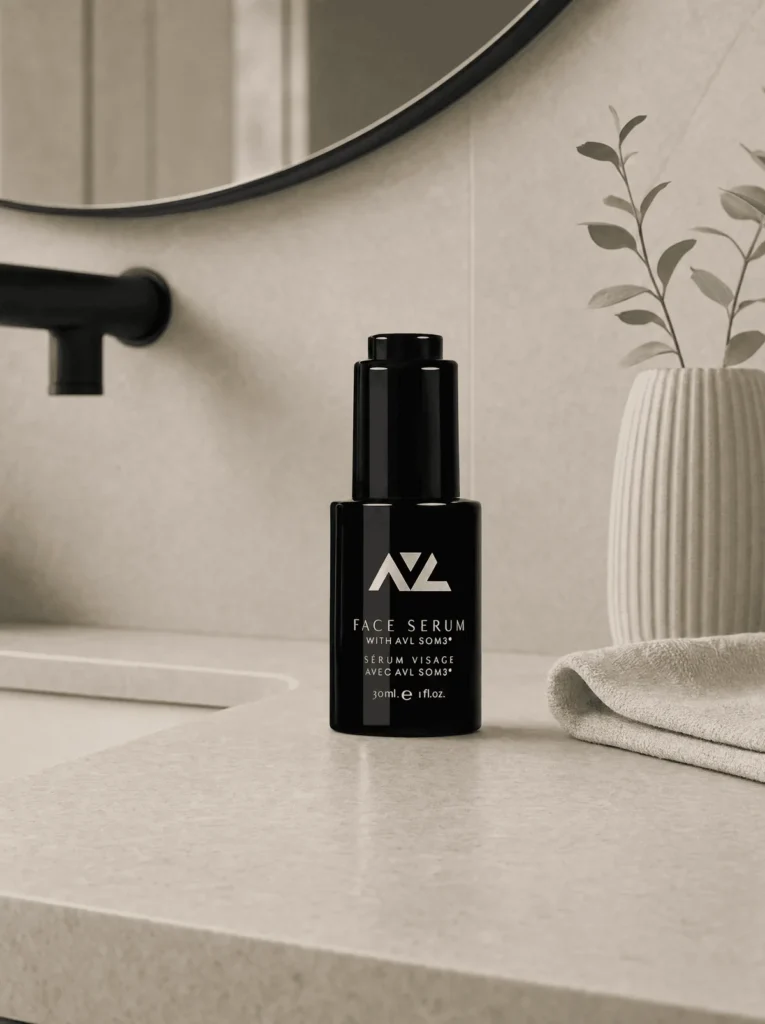
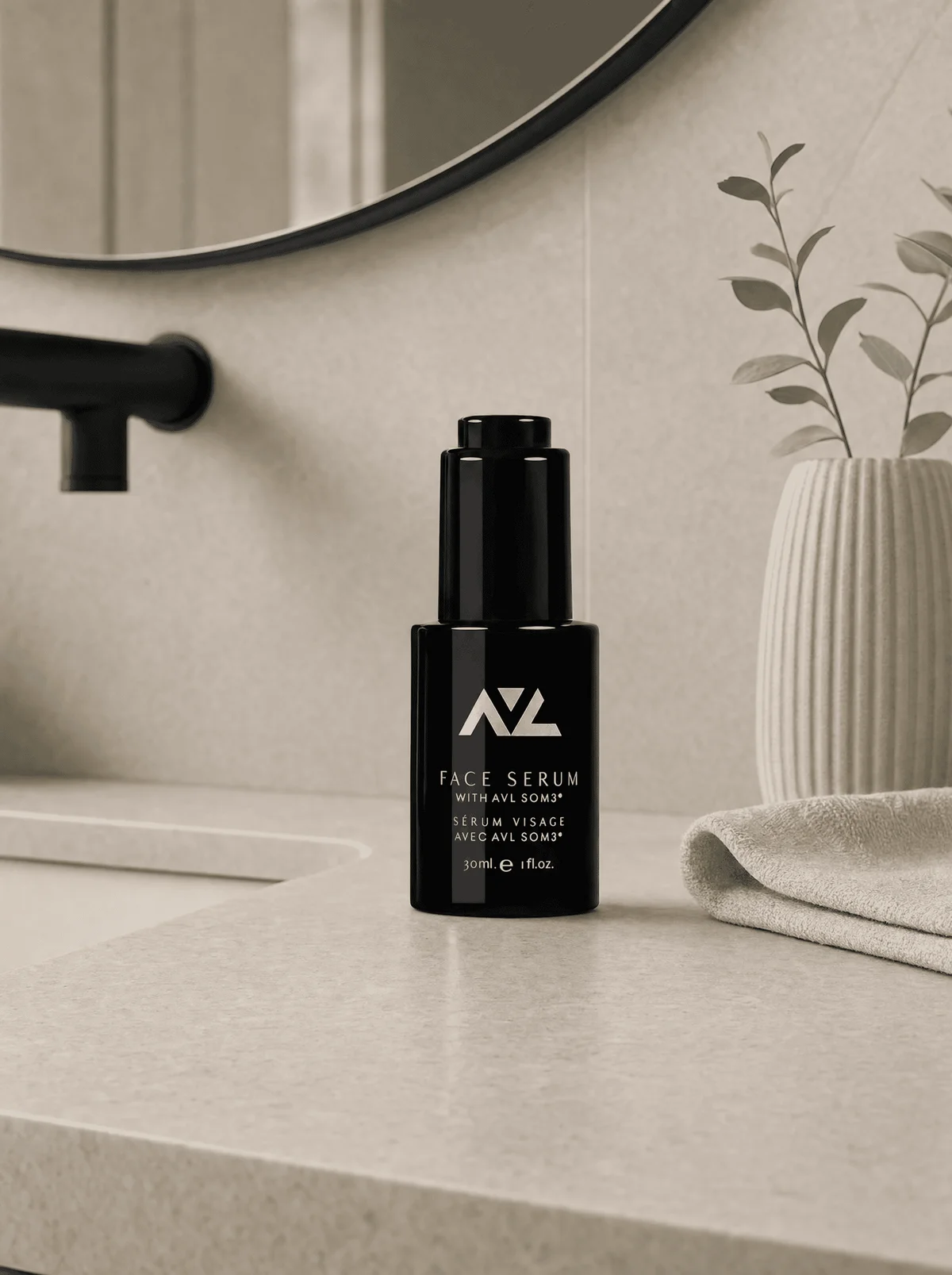
There’s a small black box on my bathroom counter that costs more than my car payment. $283 of skincare, to be exact: the AVL Face Serum at $195 and the AVL Face Mist at $88.
I’ve spent eight years reading beauty claims for a living, and I’ve learned that a box arriving is not a review. So before you believe a word I say about wrinkles, let me be clear about the timeline: the box landed on September 4, 2026, and I’m writing this on September 9. That’s five days. AVL’s own marketing promises visible results in 28 days, so I’m not going to sit here and tell you my fine lines are gone. They’re not. That’s the whole point of this post.
What I can tell you after a week: what these products actually are, what’s in them, how they feel, how long a bottle lasts, and whether the science behind AVL SOM3 holds up when you read it closely. I’ll come back with my real 28-day results on October 2, good or bad.
What AVL Laboratories actually is
AVL is a biotech skincare brand based in North Redington Beach, Florida. The line is small: a face serum, a face mist, two face creams and an eye cream, with prices running from $88 to $195 per product. That puts it in the same bracket as La Mer and Augustinus Bader.
The brand’s pitch is skin longevity rather than anti-aging. The argument: aging skin is under-nourished skin, and feeding it the raw materials it needs works better than forcing it with an active. AVL says the formulas took five years to build, with $10 million in research and development, manufactured in an FDA-registered facility.
Those are the brand’s own figures, not independently audited ones. I’m repeating them so you know what AVL is claiming, not because I’ve verified the R&D spend myself.
AVL SOM3: I counted the amino acids myself
Everything is built around AVL SOM3, a patented complex that supplies all 20 amino acids — the building blocks your body uses to make collagen and elastin. AVL’s claim is that it supports three things at once: structure through collagen, elasticity through elastin, and cellular energy through NAD.
Here’s the part I like. I read the full ingredient list on the serum and counted. Glutamine, arginine, lysine, leucine, isoleucine, threonine, valine, histidine, tyrosine, phenylalanine, cystine, methionine, glutamic acid, aspartic acid, asparagine, proline, serine, tryptophan, alanine and glycine — all 20 are there. So the hero claim is literally true, and you can check it yourself on the label. That’s more than a lot of luxury brands can say.
Here’s the part I’m more careful about. Amino acids sitting in a bottle are not the same as amino acids delivered into the dermis, where collagen is actually made. Skin is a barrier. It’s designed to keep things out, and getting building blocks into the living layer is genuinely hard. AVL isn’t claiming to be a drug and doesn’t need to prove drug-level efficacy — that’s worth understanding before you read any “clinically proven” line on any beauty product, including this one.
The serum: the nicest texture I’ve tested this year
The AVL Face Serum is $195 for 30ml, meant for use twice a day. It’s a lightweight, silky, fast-absorbing serum that sinks in within about 30 seconds and leaves skin looking smooth and slightly blurred immediately. That instant smoothing is real — and it has a straightforward explanation.
Dimethicone is the second ingredient on the list, right after water. Dimethicone is a silicone, and silicones are what create that soft-focus, filled-in finish the moment you apply something. I’m not saying that as a criticism. It feels lovely and it makes makeup sit beautifully on top. I’m saying it because if you apply this and think “my fine lines look better already,” that’s the silicone doing its job in the first minute. It’s not collagen. Those are two different things on two very different timelines.
Underneath, the actives are a sensible stack: niacinamide, which is well supported for barrier support and dark spots; acetyl hexapeptide-8, the peptide sold as Argireline; and ferulic acid, a strong antioxidant that also stabilizes vitamins C and E.
One honest note on concentration: acetyl hexapeptide-8 sits below phenoxyethanol on the ingredient list, and preservatives like that are typically used at around one percent. That placement usually means the peptide is present at under one percent too. Niacinamide sits higher, above the preservative, which suggests a more meaningful amount.
Texture-wise, this is the nicest serum I’ve tested this year. Fast absorption, no tackiness, and it layered cleanly under sunscreen and makeup every single morning.
The mist: the one I reached for most
The AVL Face Mist is $88 for 50ml — a fine, non-sticky hydrating spray you can use over bare skin or on top of makeup. It carries the same AVL SOM3 complex as the serum, plus hyaluronic acid, aloe, panthenol and rose water. Of the two products, this is the one I lived with most.
The spray is genuinely good. It’s a true fine mist, not the fat droplets that wreck makeup, and it dried down in under a minute every time. I used it three or four times a day, mostly at my desk, and it did not disturb foundation once.
AVL’s clinical note for the mist says 100% of participants showed improved skin moisture, and 91% maintained barrier function at six hours. Read the asterisk though: that trial was 11 people. Eleven is a very small study, and AVL discloses it plainly, which I respect more than brands that hide the sample size entirely. The hydration claim is also the easiest in skincare to hit — hyaluronic acid, glycerin and aloe will improve a moisture reading on almost anybody. What it doesn’t tell you is anything about wrinkles. Treat the mist as an excellent hydrator, which it is, and not as a wrinkle treatment in a spray bottle.
Serum vs. mist: buy the mist first
My advice is simple: start with the $88 Face Mist. It’s less than half the cost of the serum, it uses the same AVL SOM3 complex, and it delivers the one benefit you can actually judge within a week — hydration. If your skin responds well after a month, step up to the $195 serum with real information instead of hope. The mist answers the question “does my skin like this” for $107 less.
One exception: if your main concern is fine lines rather than dryness, the mist won’t touch it. Go straight to the serum, or skip the brand entirely.
What the clinical numbers actually mean
AVL’s results are real consumer studies, but they’re small, and they measure what participants reported, not drug-level efficacy. The serum figures come from 26 people aged 40 to 60. The mist figures come from 11.
Here’s the thing almost nobody explains, and it’s the most useful part of this post. In the United States, the FDA draws a line between a cosmetic and a drug: a cosmetic changes appearance, a drug changes the structure or function of the body. Anti-aging skincare is sold as a cosmetic. That’s why the language is always “reduces the appearance of fine lines” and never “reduces fine lines.” Look at AVL’s own benefit list — “Reduce Appearance of Fine Lines and Wrinkles.” That wording is deliberate, and it’s legally required.
So when you read “96% reduced appearance of fine lines and wrinkles,” it means 96% of 26 people, in a questionnaire, said lines looked better. It doesn’t mean a measured 96% reduction in wrinkles. None of this makes AVL dishonest — every brand at this price does exactly the same thing, and AVL discloses its sample sizes where many do not. It does mean you should read the asterisk on any luxury serum before you spend $195 on it. Once you can read a claim like that, you can read every brand’s claims.
How this compares to what else is in that price range
AVL sits in the same $150 to $250 bracket as OneSkin, Augustinus Bader and La Mer, chasing the same longevity-minded customer. Against the products I’ve actually tested, AVL wins clearly on texture, holds its own on ingredient transparency, and loses on price per milliliter — and on how quickly you can tell whether it’s working.
If you want the same actives for a fraction of the money, that’s genuinely possible. Niacinamide and ferulic acid are cheap and widely available, and a good drugstore version of a retinol will almost certainly do more for fine lines over six months than any $195 serum will. AVL is a nourishing, gentle, feel-good approach. A retinoid is the aggressive, evidence-heavy approach. They’re different strategies for the same goal.
What I actually did for five days
I used the serum twice a day as directed, four drops each time, pressed into clean skin on my face, neck and chest — ten applications total. I used the mist three to four times a day, over bare skin in the morning and over makeup in the afternoon. I didn’t change anything else in my routine during those five days, so any reaction was attributable to the AVL products.
What I can report honestly: the texture is excellent, absorption is fast, and there was no stinging, no breakouts and no irritation. My skin looked smoother from the first application — which I attribute to the silicone rather than to the amino acids. What I can’t report yet: anything about fine lines, dark spots or firmness. Those need the full 28 days, and AVL’s own materials say so.
Five days tells you whether a product is pleasant and whether it breaks you out. It tells you nothing about whether it works. Anyone selling you 28-day results after five days is selling you something.
Who this is actually for
AVL suits someone past 35 with a real skincare budget, dry or sensitive skin that reacts badly to retinoids, and a preference for gentle formulas. It’s a poor fit if you’re under 30 (where sunscreen matters far more than any serum), if you’re treating acne or oil, or if you want the strongest possible evidence per dollar and haven’t tried a retinoid yet.
If you’re buying, here’s what I’d avoid. Don’t judge it on day one — the immediate blur is dimethicone, and the real claim is a 28-day one. Don’t skip sunscreen because you bought an expensive serum. Don’t layer it over a strong acid or retinoid the same night — alternate nights instead. And don’t mist then walk away: press it in or follow with a moisturizer to seal it, because water evaporating off bare skin can leave you drier. Finally, don’t let the 45-day money-back guarantee expire while you’re still deciding — mark day 40 in your calendar the day the box arrives.
The verdict: 4 / 5, with a one-week asterisk
Beautiful formula, real science, genuinely steep price. The formula is well built, the amino acid claim is verifiable, the texture is the best I’ve tested this year, and the 45-day guarantee makes trying it a low-risk decision — the real risk is your time, not your $195.
But five days is not enough evidence, and anyone who tells you otherwise after a week is guessing. My honest advice as of September 2026: start with the $88 Face Mist, and let your skin answer the only question that matters in week one — whether it’s happy.
Quick facts
- Serum: $195 for 30ml — roughly $2.60 a day (a bottle lasts about 75 days at the directed dose)
- Mist: $88 for 50ml — the smarter first buy
- Subscribing drops the serum to $156 and the mist to $70.40; free shipping over $150
- 45-day money-back guarantee on both products
- AVL SOM3: all 20 amino acids, verifiable on the label
FAQ
Is AVL Laboratories legit?
Yes. It’s based in North Redington Beach, Florida, manufactures in an FDA-registered facility, and publishes its clinical sample sizes openly. The products are real and well formulated. The open question isn’t legitimacy — it’s whether the results justify a $195 price for you.
How long does a serum bottle last?
About 75 days at the directed dose. AVL says three to five drops twice daily, and at four drops a typical dropper delivers roughly 0.2ml per application, or 0.4ml a day. That puts a 30ml bottle at around two and a half months — roughly $2.60 a day.
Does the serum really work in 28 days?
AVL’s 28-day claim comes from a study of 26 people aged 40 to 60, where 96% reported a reduced appearance of fine lines. That’s self-reported data from a small group, not a measured wrinkle reduction. I’ll update this post with my own 28-day results on October 2, 2026.
Can you use AVL products with retinol?
Yes, but not in the same application. Use your retinoid on alternate nights and the serum on the nights in between, or apply AVL in the morning and your retinoid at night. Layering a peptide serum directly over a fresh retinoid application increases irritation risk without adding benefit.
Is there a discount code?
Code girlnamedjazz takes 10% off at avlaboratories.com as of September 2026 — a disclosure, since this post contains affiliate links. Subscribing saves 20% on an ongoing basis, which is the larger discount if you already know you want to keep using the products.
Do you need both the serum and the mist?
No. They share the same AVL SOM3 complex, so they overlap. Buy the $88 mist first to find out whether your skin responds well to the brand, then add the $195 serum only if you want the fuller active stack aimed at fine lines.
A note from the studio
I’ve bought plenty of expensive serums because the ad said so, and this is the first time I’ve actually checked the label before believing the box. AVL made one hard thing easy for me: the hero claim was countable. That’s not magic — it’s just honesty in the ingredient list — and it’s worth more than any 28-day promise until I’ve lived the 28 days myself.
Tested on my vanity, not on my ego.